
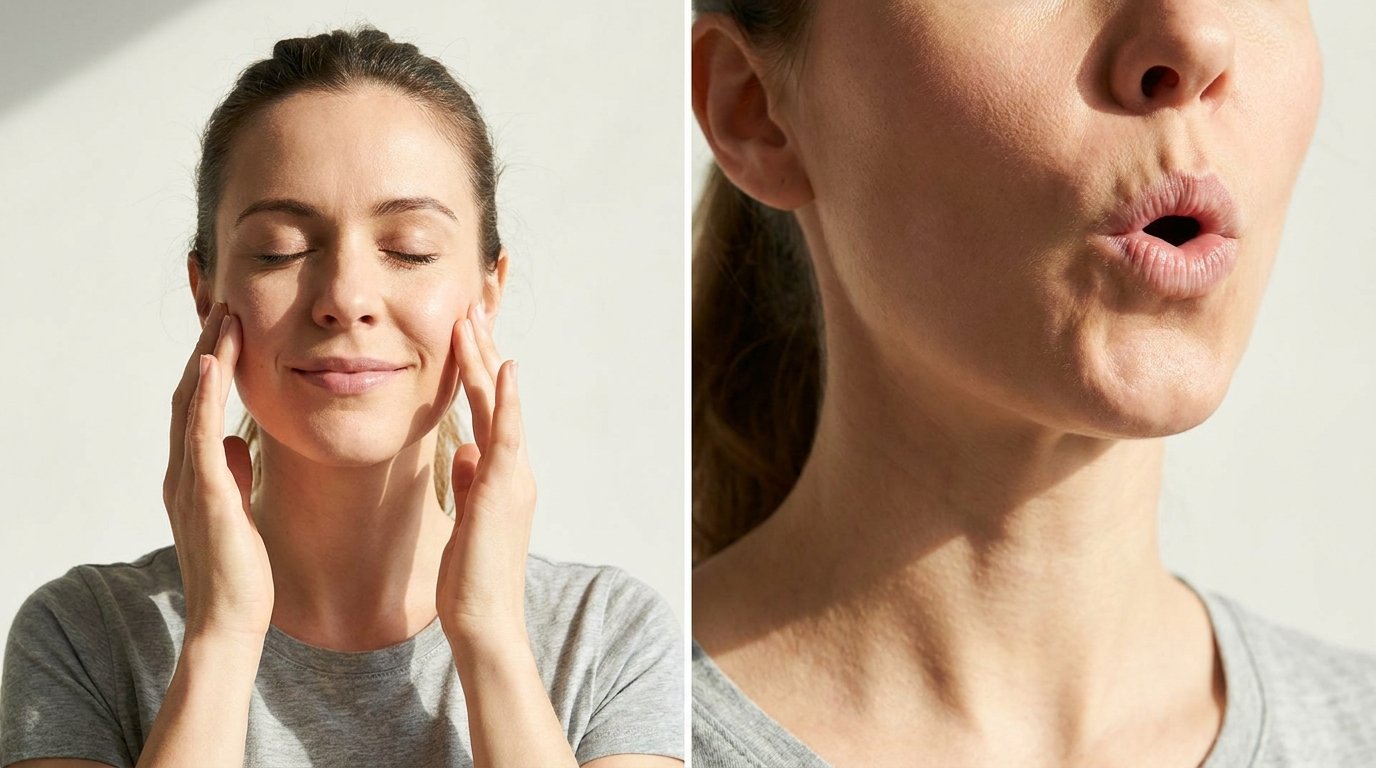
By Sonia Singh, certified face yoga instructor
Jowls are the question I get asked about most. That softening along the jawline, the loss of a clean edge between the jaw and the neck, is one of the first changes people want to work on. The good news is that the muscles in this area respond well to regular, targeted practice.
The catch is that most jowl routines you’ll find online only work the jaw itself. That’s half the job. Below I’ll explain why jowls actually form, then give you a routine that lifts from the cheeks down, which is the part that makes the difference.
What causes jowls?
Jowls aren’t caused by one thing, and knowing what’s behind yours helps you set fair expectations. The main contributors are:
- Less collagen and elastin. As we age the skin makes less of both, so it holds its shape less tightly.
- Fat pad movement. The fat pads in the face shift and shrink over time. When volume drops from the cheeks, it can settle lower and add weight around the jaw.
- Weaker muscle and fascia. The support layer that holds the face “up” loosens with age.
- Gravity, genetics and lifestyle. Gravity pulls everything down slowly over the years, family patterns play a part, and sun exposure, smoking and rapid weight loss all speed things up.
The key insight most articles miss: the weight that forms a jowl is partly falling from the mid and upper face. So a routine that only pushes the jaw around is treating the symptom, not the cause.
Can face yoga really help jowls?
Honestly, it depends what you’re expecting. Face yoga strengthens and tones the muscle layer under the skin and boosts circulation, which can make the lower face look firmer and more lifted over time. What it won’t do is reverse significant, advanced sagging, that’s a job for a professional and possibly a clinical treatment.
Formal research on jowls specifically is thin. What we do have (the wider facial-exercise studies) points to gradual muscle and firmness improvements with consistent practice. So treat this as a genuinely useful maintenance and prevention habit, not an overnight fix.
The principle: work the whole face, not just the jaw
Because jowl weight comes from above, this routine starts at the cheeks and mid-face, then moves to the jaw and neck. Lifting the mid-face takes some of the load off the jawline. Work in this order and you’ll get more from the same ten minutes.
As always: clean hands, clean face, a drop of oil or serum so your fingers glide, and never drag or crease the skin.
Your jowl-lifting routine
1. Warm-up tapping (30 seconds) Using your fingertips, tap briskly all around the lower face, jaw, and lower cheeks. This wakes up circulation and brings blood to the area before you start.
2. Cheek lifter (repeat 10 times) This is the mid-face lift that takes weight off the jaw. Make an “O” with your mouth and fold your top lip over your teeth. Smile to lift the cheek muscles, hold for a moment, then release. Feel the cheeks doing the work. Repeat 10 times.
3. O-to-smile (30 seconds) Keeping your lips wrapped over your teeth, move your mouth from an “O” shape to a smile and back again, over and over. Keep the jaw relaxed rather than clenched. This works the ring of muscle around the mouth that supports the lower face.
4. Lower-jaw-forward stretch (repeat 8 times) Sit tall and tilt your head back slightly. Gently push your lower jaw forward and up until you feel a stretch along the jawline and front of the neck. Hold three seconds, relax, and repeat eight times. This is the move that most directly targets the jawline edge.
5. Knuckle jaw massage (30–60 seconds) Make loose fists and use your knuckles to massage along the top of the jawbone in small circles, starting at the chin and working out towards the ears. Lift off and return to the chin to repeat. This drains fluid and boosts circulation right where jowls form.
6. Neck firmer (repeat 5 times) Place a hand flat on the front of your upper chest to anchor the skin. Tilt your head back and look at the ceiling, then gently press your lower lip up until you feel the front of the neck engage. Hold three seconds and release. The neck and jaw work together, so a firmer neck supports a cleaner jawline.
7. Finish (30 seconds) Tap gently all over the lower face again, then rest warm palms over your jaw and take a few slow breaths.
How often, and when will you see results?
Daily is ideal, but most days of the week works. Five to ten minutes is plenty if you’re consistent. As with the muscles anywhere else in the body, results come from repetition over time, not intensity.
Give it around four to twelve weeks before you judge it. Early on you’ll mostly notice the area feels less tense and looks a little more awake; firmer tone builds gradually after that.
Prevent jowls from getting worse
A few everyday habits protect the work you’re putting in:
- Mind your “tech neck.” Looking down at a phone for hours shortens the front of the neck and drags the lower face down. Lift the phone to eye level.
- Wear sunscreen daily. Sun damage breaks down collagen faster than anything else.
- Sleep and hydrate. Both support skin quality and recovery.
When to see a professional
Face yoga is a great maintenance tool, but if your jowls are pronounced and bothering you, it’s worth talking to a dermatologist or cosmetic professional about your options. Face yoga can sit alongside those treatments; it doesn’t have to be one or the other.
Frequently asked questions
What actually causes jowls?
A mix of reduced collagen and elastin, shifting facial fat, weakening muscle and fascia, gravity, genetics and sun exposure. Usually several of these together rather than one cause.
Can you get rid of jowls with exercise?
Exercise can tone the underlying muscle and make the area look firmer, and it’s a good preventive habit. It won’t fully remove advanced jowls, which may need clinical treatment.
Does face yoga work for jowls?
It can help the lower face look firmer and more lifted with consistent practice, though the research specific to jowls is limited. Expectations matter: gradual improvement, not a dramatic overnight change.
How long until I see a difference?
Most people notice the area feels less tense quickly, with firmer tone building over roughly four to twelve weeks of near-daily practice.
Want this matched to your jawline?
Jowls show up differently on every face, and the fastest results come when the routine is built around where your weight is actually sitting. In a one-on-one online session I assess your face, correct your technique, and give you a targeted jaw-and-cheek routine to follow. Online, Australia-wide.
This article is for general information and isn’t medical advice. Jowls can have medical causes; if you’re concerned, see a doctor or dermatologist.