
By Sonia Singh, certified face yoga instructor
Eye bags and hooded eyes get lumped together, but they’re different problems with different fixes. Do the wrong exercises for your concern and you’ll waste your effort. So before any routine, let’s work out what you’re actually dealing with, then match the right approach to it.
A quick word first, because it matters more here than anywhere else on the face: the skin around your eyes is the thinnest on your body. Everything below is done feather-light. No dragging, no pulling.
First, know your concern
- Under-eye bags / puffiness. Fullness or swelling below the eye. Often worse in the morning and driven by fluid, though it can also be structural (fat pads shifting with age).
- Hooded eyes. Extra skin or a drooping upper lid that partly covers the eye, making it look smaller or heavier. This is more muscle- and structure-based.
- Dark circles often ride along with both, and improve mostly through circulation and sleep.
Quick test: if your under-eye fullness is worse in the morning and eases through the day, it’s largely fluid, which responds well and fairly fast to face yoga. If it’s constant regardless of time of day, it’s more structural, and improvements will be slower and more modest.
What causes under-eye bags
Three main things, often together:
- Sluggish lymphatic drainage. Fluid pools under the eyes, especially overnight. This is the most improvable cause.
- Weakened muscle tone around the eye (the orbital muscle), which lets things droop.
- Thinning skin and shifting fat pads with age, which is structural.
Face yoga helps most with the first two. The structural part is where its limits are.
The gentleness rule
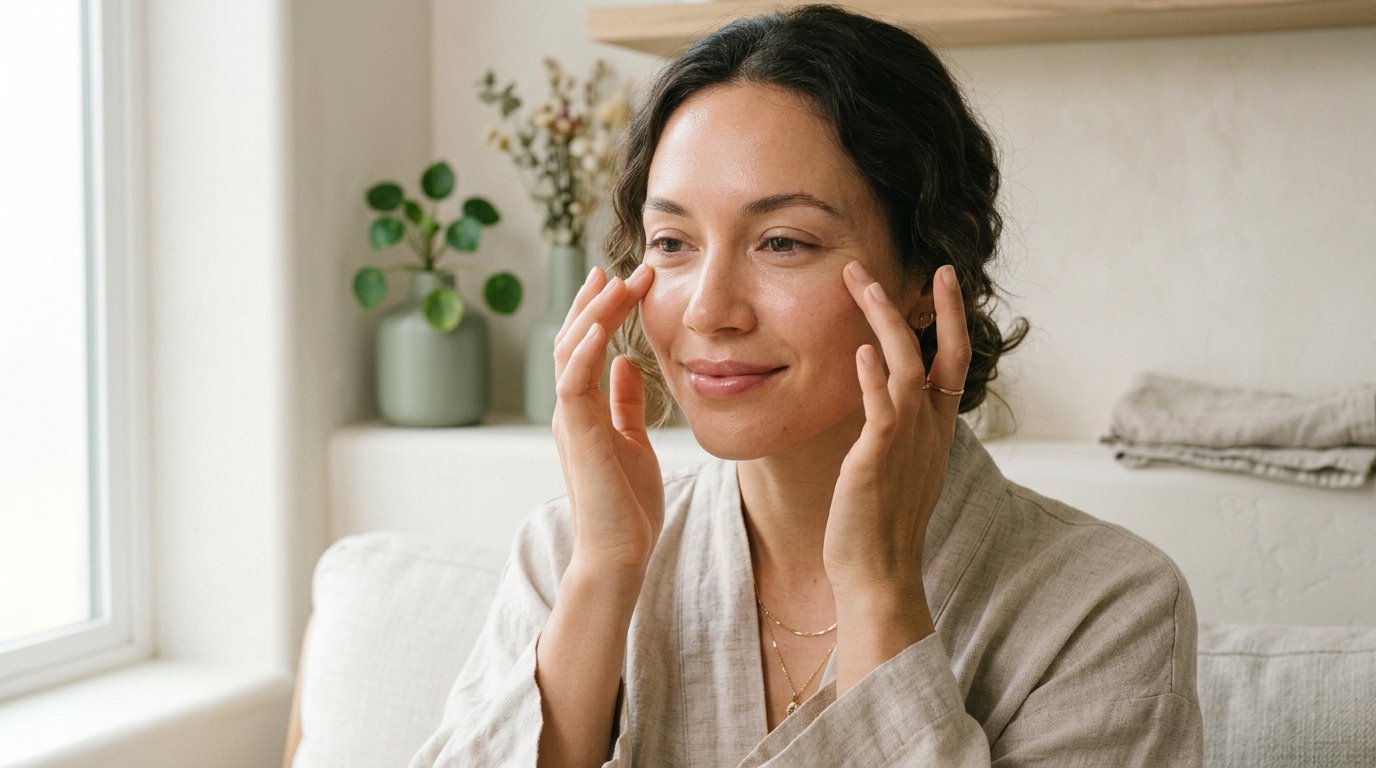
Because the skin here is so delicate, every eye exercise follows these rules: use your ring finger (it’s the weakest, so you press lightest), keep the touch feather-light, never drag or stretch the skin, and stop if anything feels like pulling. You’re encouraging fluid and gently working muscle, not manipulating skin.
Routine A: for eye bags and puffiness (fluid focus)
This routine drains fluid and boosts circulation. Best done in the morning.
1. Eye circles (30 seconds) Rest your ring fingers at the inner corners, by the bridge of your nose. Feather-light, tap outward along under the eye to the outer corner, up to the temple, and along the brow back to the start. Keep circling gently.
2. Inner-to-outer drainage (30 seconds) With ring fingers, gently sweep from the inner corner outward toward the temple, then press softly at the temple to encourage drainage there. This moves pooled fluid toward where the body clears it.
3. Temple press (15 seconds) Press gently at your temples with your fingertips and hold, breathing slowly. Helps circulation around the whole eye area.
4. Look up and down (30 seconds) Keeping your head still, look up as far as comfortable, then down, slowly. This gently works the eye muscles and encourages movement of fluid.
Routine B: for hooded eyes (lift focus)
This routine works the muscles that lift and open the eye. Slower to show results, so be patient.
1. Brow lift hold (repeat 5 times) Place your index fingers just under your eyebrows and gently lift them up a touch. Now try to close your eyes slowly against that light resistance. Hold a few seconds, release. This works the muscles that lift the lid.
2. Gentle eyelid strengthener (repeat 5 times) Look straight ahead. Slowly lower your upper lids halfway (a soft, relaxed squint) without scrunching, hold, then open wide. Keep the forehead still so the lid muscles do the work, not your brow.
3. Forehead release (20 seconds) Rest your fingertips flat on your forehead and consciously relax it. Many people compensate for hooding by lifting the forehead all day, which builds tension. Releasing it helps.
Lifestyle matters (a lot) for puffiness
Because so much under-eye puffiness is fluid, these often help more than any exercise:
- Sleep enough, and sleep with your head slightly elevated.
- Go easy on salt, which encourages fluid retention.
- Stay hydrated (dehydration can worsen puffiness).
- Check allergies — they’re a common, overlooked cause of puffy eyes.
What to expect
Fluid-based puffiness can improve quickly, sometimes within days to a couple of weeks, especially with the lifestyle tweaks. Muscle tone for hooded eyes is slower, think 8 to 12 weeks of gentle, consistent practice. Structural bags change little from exercise alone.
When to see a professional
If your under-eye bags are pronounced and constant (structural), or hooding significantly affects your vision or really bothers you, a dermatologist or eye specialist can advise. Face yoga is a good complement, not always a full solution.
Frequently asked questions
Does face yoga reduce eye bags?
It helps a lot with fluid-based puffiness through lymphatic drainage and circulation, and modestly with muscle tone. Structural, fat-pad bags respond much less.
Can face yoga fix hooded eyes?
It can gently strengthen the muscles that lift the lid, which may help mild hooding over time. Significant hooding is structural and may need professional treatment.
What causes under-eye bags?
Mainly sluggish lymphatic fluid, weakened eye-area muscle tone, and age-related thinning skin and fat-pad changes. Morning-only puffiness is usually fluid.
Is face yoga safe around the eyes?
Yes, if you’re gentle. Use your ring finger, keep the touch feather-light, and never drag the delicate skin.
How long until I see results?
Fluid puffiness can improve within days to weeks; hooded-eye muscle tone takes around 8 to 12 weeks of consistent, gentle practice.
Want the right routine for your eyes?
Because eye bags and hooded eyes need different approaches, getting the right one matters. In a one-on-one online session I’ll look at your eye area and give you the correct, gentle routine for your concern. Online, Australia-wide.
This article is for general information and isn’t medical advice. Persistent or sudden under-eye swelling should be checked by a doctor.